Introduction to the Issue of Thermal Bridges
Thermal bridges are one of the key challenges in designing and operating industrial installations and high-temperature insulation systems. These are areas of increased thermal conductivity through which uncontrolled heat or cold loss occurs, leading to energy losses, reduced process efficiency, and increased operational costs. This article delves into the topic of thermal bridges, discussing their types, causes, elimination methods, and modern technologies for minimizing their impact.

Types of Thermal Bridges and Their Causes
Thermal bridges occur in various forms depending on the specifics of the installation and the insulation materials used. The most common types are:
- Point Thermal Bridges: These form at connections between structural elements, such as bolts, rivets, or anchors, which conduct heat more efficiently than insulating materials.
- Linear Thermal Bridges: These are observed along edges or joints of insulation mats, where the insulation layer lacks continuity.
- Surface Thermal Bridges: These involve large areas, such as insufficiently insulated valves or pipes.
The causes of thermal bridges can be divided into:
- Design Errors: Insufficient thermal analysis during the design phase.
- Low-Quality Materials: Use of materials with poor thermal insulation properties.
- Improper Installation: Leaks or gaps resulting from incorrect joining of elements.
Insulation Materials and Their Impact on Thermal Bridges
The type of insulation material used plays a crucial role in minimizing thermal bridges. Below are commonly used materials in industrial insulation:
- Mineral and Glass Wool:
- Advantages: Resistant to high temperatures, good acoustic insulation.
- Disadvantages: Requires appropriate protection against moisture.
- Polyurethane Foam:
- Advantages: High insulation value, lightweight.
- Disadvantages: Sensitive to UV radiation and prone to degradation over time, not suitable for high temperature, flamable.
- Aerogels:
- Advantages: Exceptionally low thermal conductivity, easy to apply in tight spaces.
- Disadvantages: High production cost.
- Ceramic Insulation:
- Advantages: Resistant to extreme temperatures.
- Disadvantages: Brittle and requires specialized installation.
Methods for Eliminating Heat Loss in industrial plants:
Effectively preventing thermal bridges requires a comprehensive approach that includes design, material selection, and installation.
Insulation Design:
- Early thermal analysis allows identification and elimination of potential bridges during the design phase.
- Insulation for fittings such as valves, flanges, nozzles, and elbows should be included in the design.
- Computer modeling tools like CFD (Computational Fluid Dynamics) enable heat flow simulations.
Technical Features of the Installation:
- Ensure continuity of insulation by using overlapping joint systems.
- Apply sealing tapes and flexible fillers in areas difficult to insulate.
Modern Technologies:
- Heat Recovery Systems: Minimize energy losses by recovering heat from industrial processes.
- Thermal Insulation Coatings: Nanotechnology enables coatings with high insulation properties at minimal thickness.
Inspection and Maintenance:
- Regular thermal imaging inspections detect thermal bridges and evaluate the state of insulation.
- Repairing damage and upgrading insulation improve energy efficiency.
Detecting Thermal Bridges
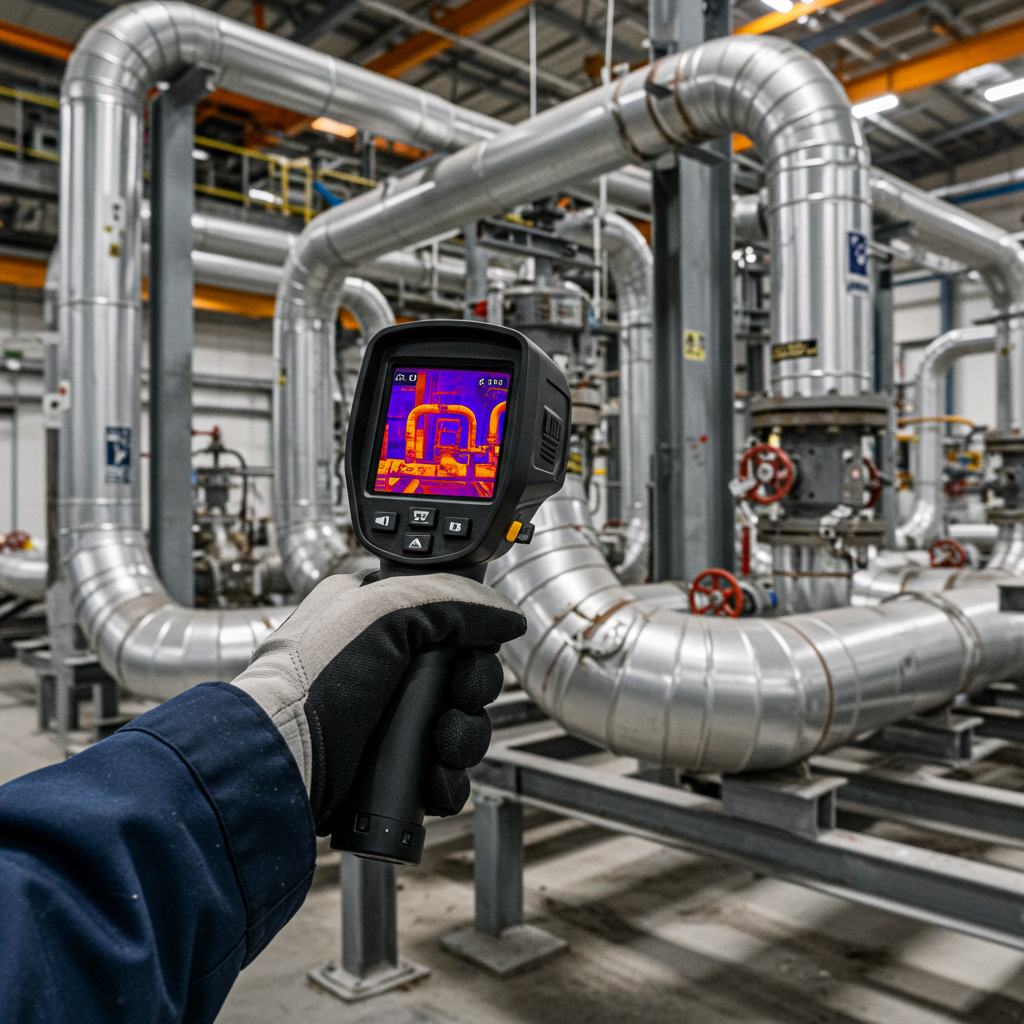
One of the most effective ways to identify thermal bridges is through thermal imaging. This technology visualizes temperature differences on the surfaces of installations, allowing for quick detection of heat loss areas. Thermal imaging is particularly useful in:
- Diagnosing insulation of pipelines and tanks.
- Quality control after installing new insulation systems.
- Preventive maintenance inspections.
Using thermal cameras allows for precise problem localization and immediate corrective action.
Example: Calculating Energy Loss in a Pipeline
To calculate energy loss due to a linear thermal bridge for a pipeline, we use heat exchange equations and simplified linear loss dependencies. Input data include:
- Nominal pipe diameter (DN): 169 mm.
- Insulation thickness: 50 mm.
- Internal medium temperature: 90°C.
- Ambient temperature: 20°C.
- Heat exchange coefficient on the surface (with 0.5 m/s air movement): approx. 8 W/(m²·K).
The linear heat loss is calculated based on the formula:
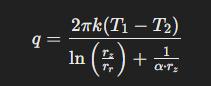
Where:
- q: Heat loss (W/m),
- k: Thermal conductivity of insulation (assume 0.035 W/(m·K) for mineral wool),
- T1: Medium temperature (90°C),
- T2: Ambient temperature (20°C),
- r: Pipe radius (0.169 m / 2),
- rz: Outer insulation radius (r+insulation thickness r + \text{insulation thickness}),
- α\alpha: Heat exchange coefficient on insulation surface (8 W/(m²·K)).
Results:
- Linear heat loss for the pipeline is approximately 11.04 W/m.
- Total annual energy loss for a 100 m pipeline is around 9672 kWh.
Addressing heat loss with Flexible Insulation Covers
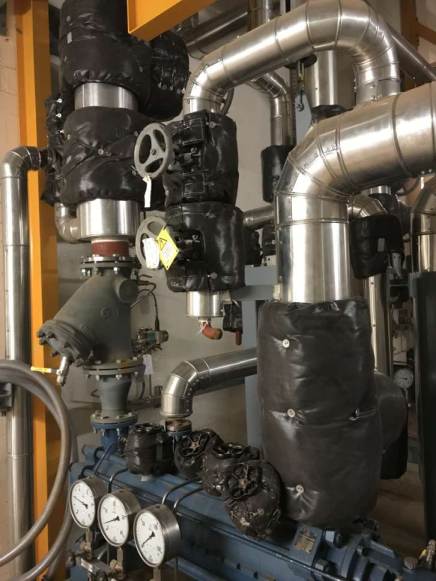
Insulation covers provide a flexible and easy-to-install solution for minimizing thermal bridges. They are particularly useful for:
- Protecting valves, flanges, heat exchangers, and other irregular shapes that are difficult to insulate with traditional materials.
- Reducing heat loss in areas requiring frequent access, as they can be easily removed and reinstalled.
- Enhancing workplace safety by lowering surface temperatures and reducing the risk of burns.
Insulation mats are made of durable materials resistant to high temperatures and environmental conditions, making them a long-lasting solution for industrial applications.
At Madrass, we produce custom-made insulation covers tailored to individual client requirements. By taking on-site measurements and designing insulation mats in 3D software, we can effectively reduce thermal bridges.
What is more, application of flexible insulation covers allows operatives to install the insulation tightly. They don’t need any special tools thanks to easy fastening methods like velcros or straps.
Industrial Applications
In industrial installations, such as power plants, refineries, or chemical plants, thermal bridges can lead to:
- Reduced efficiency of components like turbines or heat exchangers.
- Overheating of mechanical components.
- Increased risk of failures due to temperature fluctuations.
A good practice example is using a double-layer insulation system on transmission pipelines, where the outer layer protects against mechanical damage, and the inner layer reduces heat loss.
Conclusion
Thermal bridges present a challenge that requires a comprehensive technical and design approach. Choosing the right materials, proper design and installation of insulation, and regular inspections are essential to minimizing energy losses. Implementing modern technologies, such as aerogels or heat recovery systems, allows for even more efficient energy management.
Effective insulation solutions not only lower operational costs but also contribute to reducing greenhouse gas emissions, which is crucial in the global pursuit of sustainable development.
7 responses