What are the advantages of valve insulation jackets?
Easy Maintenance and Reduced Downtime thanks to Valve Insulation Covers:
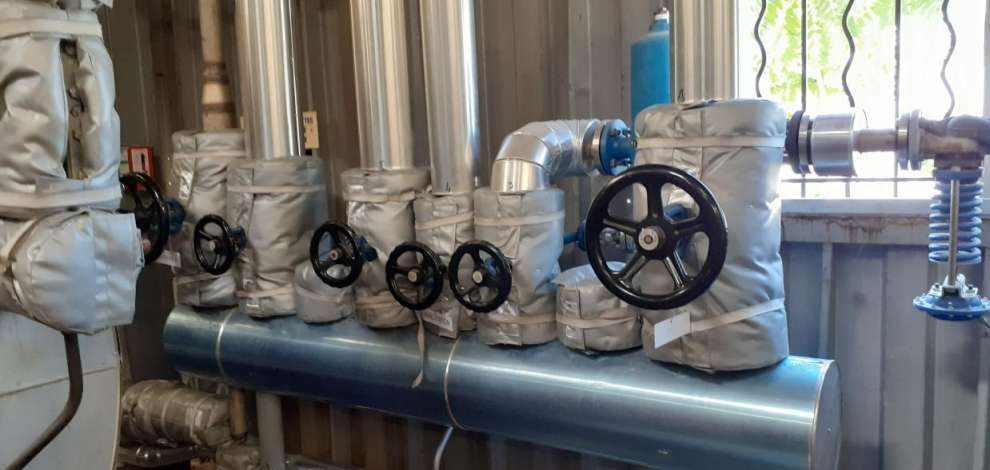
Valve insulation jackets are typically designed for easy and frequent installation and removal. This allows for quick access to valves for inspection, maintenance, or repair, minimizing downtime and keeping your operations running smoothly.
The plant contractors want to use removable valve insulation blankets due to ease of maintenance and simplicity of installation.
Valve insulation covers help with energy savings and Reduced Costs:
The primary benefit of valve insulation jackets is their ability to significantly reduce thermal bridges and heat loss from valves. This translates to lower energy consumption needed to maintain desired temperatures in your piping systems. Less energy used means lower utility bills and a positive impact on your bottom line.
Improved System Efficiency:
By minimizing heat loss, valve insulation covers help your entire system operate more efficiently. Consistent temperatures throughout the system ensure optimal performance and prevent unnecessary wear and tear on equipment.
Enhanced Safety:
Hot valves can pose a serious safety hazard to personnel working nearby. Valve insulation jackets act as a barrier, reducing the surface temperature of the valve and preventing accidental burns.
Protection from the Elements:
Valve insulation blankets not only insulate against heat loss, but they can also protect valves from extreme weather conditions. This includes freezing temperatures that can cause pipes to burst and damage valves, or hot environments that can degrade valve materials over time.
Lightweight solution:
Valve insulation wraps are lighter than traditional metal sheet boxes for valve insulation.
Improved acoustics:
Industrial systems transferring liquids through pipes may create additional noise. Plant operators can reduce the sound levels by using valve insulation blankets with noise absorbing properties.
Removable valve insulation jackets provide frost protection
For systems exposed to negative temperatures, valve insulation blankets provide protection against freezing.
Reliable valve insulation jackets suppliers like ourselves, can advice you on the best choice of materials and solutions.
How are valve insulation covers built?
Valve insulation wraps consists of several types of materials. In general, we can say that consist of:
- external fabric
- insulation filling
- internal fabric
- fixing systems
- optionally, we also offer valve insulation blankets with heating elements
Let’s elaborate a bit more on each of these elements.
External fabric of industrial valve insulation solutions
This outer skin provides protection from mechanical damage and separates the insulation filling from environmental conditions. This fabric can include different finishing layers depending and the application area and temperature of application.
- PU coated – up to 500 deg C
- PTFE (telfon) coated – up to 250 deg C
- Silicone coated
There are numerous types of industrial fabrics used for the production of valve insulation. These are made from glass fibers, silica fabrics, alumina fabrics or aramid fabrics just to name a few.
Each of these materials has it’s own unique properties and application areas.
Insulation filling for removable valve insulation jackets
The inside of the valve jacket can be filled with almost all flexible insulation materials. The wide choice allows sus to select from glass wool, mineral wool, ceramic wool, needlemats, aerogels or even elastomeric foams.
Internal fabric for pipe and valve insulation jackets
Similarly to the external fabric, we have the same choice of materials. Sometimes, the internal fabric can differ to the external. This allows us to achieve better properties of the valve insulation blanket and optimise costs. For example, the internal part can be made from the PU coated fabric due to the contact with a hot pipe or valve. Whereas for the external fabric we can use the silicone coated material.
Fixings of valve insulation covers
Customers like easy access and maintenance, therefore, they often specify fixings that allow them to do it. The types of fixings which you can chose from the valve insulation are:
- Velcro straps
- buckle straps
- wire hooks
These fixings allow the plant service team to quickly adjust the fitting of the valve insulation, removal and installation.
How much energy you can save by utilising valve insulation wraps?
European Industrial Insulation Foundation created a great White Paper on that topic. You can access it here. If you don’t want to read the entire document, here’s the summary about the energy savings from implementing industrial valve insulation solutions.
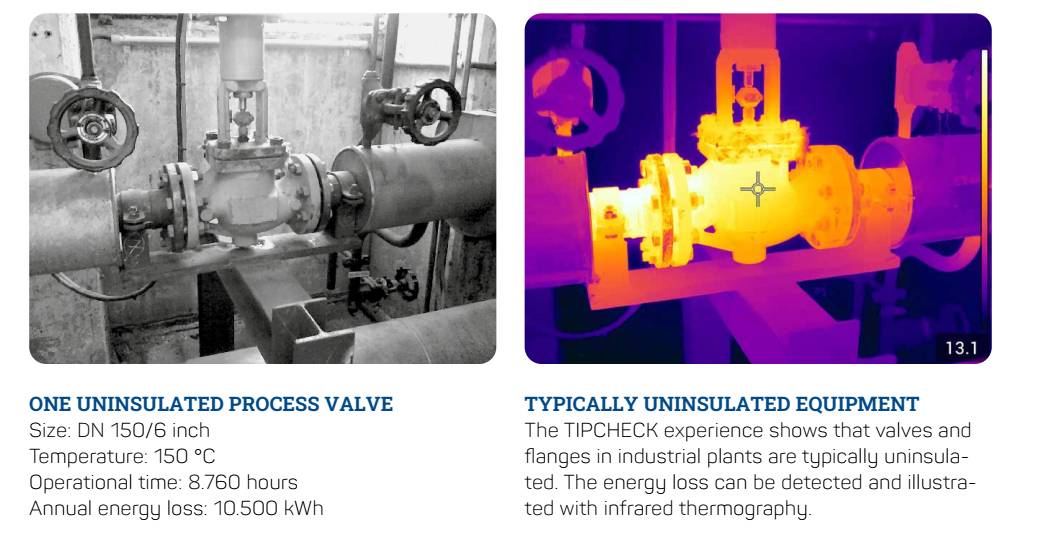
Let’s take the example from the photo: uninsulated valve – DN 150 (6 inch), operating temperature of 150 deg C. Annual energy loss can amount to a massive 10,500 kWh. And this is just from a single valve. Now multiply that number by total quantity of valves in the system and final amount is even more shocking.
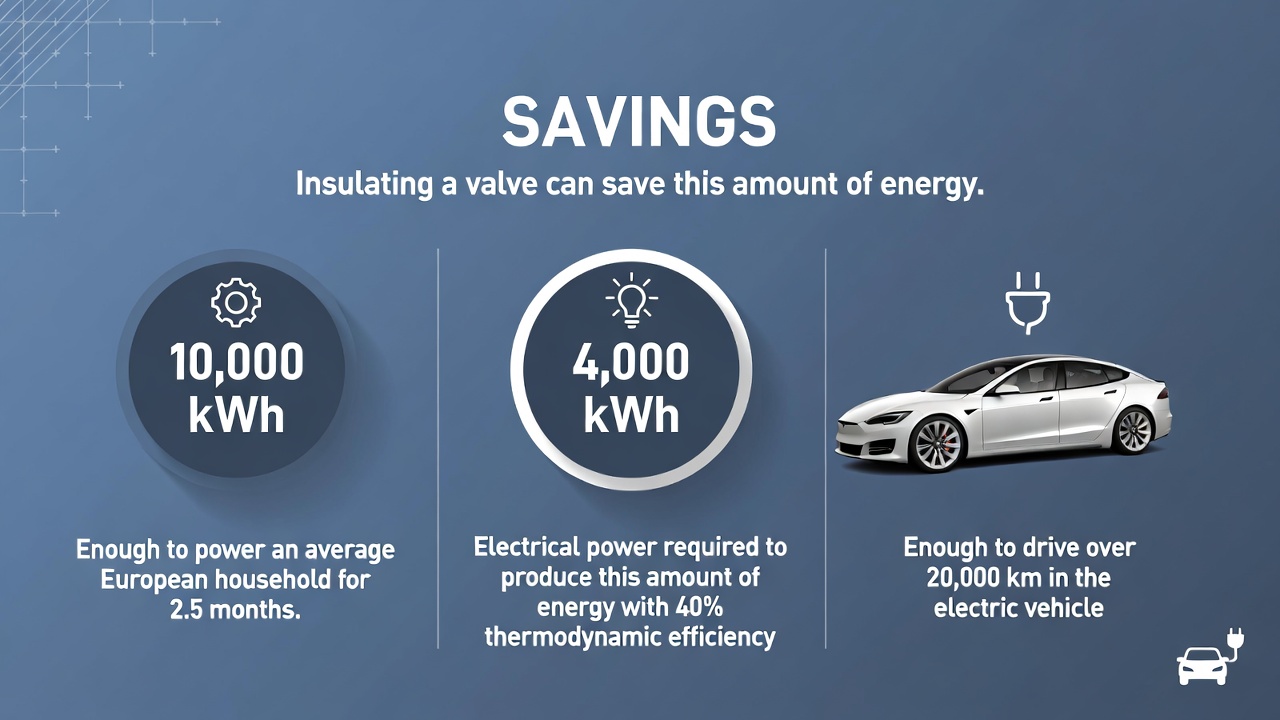
By adding insulation to the valve, you can achieve savings of 10,000 kWh in energy. If you convert that preserved 10,000 kWh of thermal energy at a 40% thermodynamic efficiency rate into 4,000 kWh of electrical power, and then apply it to recharge an electric vehicle’s battery, it would enable you to travel over 20,000 kilometers.
The table below presents comparison between uninsulated and insulated valve:
| Parameter | Uninsulated (Bare) | Insulated (Valve Jackets) | Savings / Improvement |
| Annual Heat Loss | 10,500 kWh | ~525 kWh (5%) | ~10,000 kWh saved (95% reduction) |
| Equivalent Energy Cost (at €0.20/kWh) | €2,100/year | €105/year | €2000/year saved |
| Equivalent EV Driving Distance | – | From saved 10,000 kWh thermal → 4,000 kWh electric (40% eff.) → >20,000 km | |
| Payback Period (Typical Jacket Cost €200–€400 installed) | – | 6–12 months | Very fast ROI |
| CO₂ Emissions Reduction (approx.) | ~2.1–3.2 tons/year | ~2.0–3.0 tons/year saved | Significant decarbonization |
| Safety / Touch Temperature | >80°C (burn risk) | <50°C (safe touch) | Improved worker safety |
What’s the cost of valve jackets?
Of course the answer is – it depends. Valve jackets can cost from as low as £30 per item (approx. 35 EUR or 41 USD) up until £200-300 per item ( approx. 230 EUR – 250 EUR or 275 USD – 410 USD) . The cost of valve jackets depends on the application temperature, material used, fixings and sizes.
Need custom valve jackets? Get a free quote.
Case study: Insulated Valve Jackets for a large power plant
Valve insulation jackets play a critical role in enhancing energy efficiency and protecting plant equipment. Our high-quality valve insulation covers are designed to fit various valve types and are a popular choice among industrial projects.
These products are one of the most popular next to turbine insulation blankets, heat-exchanger insulation jackets, nuclear insulation and pre-insulated ducts.
The project we worked on was a large power plant with two boilers in the UK.
Why there were so many removable valve covers on such a project? Simply, because of the several benefits of using insulation mattresses.
Project planning and preparation of insulation blankets for valves
We began our project for manufacturing of insulation jackets for valves with the tender documents. It required that we analysed specification, drawings and bill of quantities. Our team had to prepare preliminary design and prices for various types of valves and various types of valve insulation. By checking the thermal insulation specification we were able to determine what sort of materials we were to use. Furthermore, we knew what was the range of equipment operating temperatures required for insulated valve jackets. There were numerous valves working at temperature above 400℃ (approx. 750°F). In such case high temperature insulation removable covers were necessary.
What is more, there were also valves operating at lower temperatures ranging from 40℃ to 150℃ (approx. from 105°F to 302°F). Different temperature ranges required different design for valve insulation jackets. We manufactured removable insulation covers from different textile materials with specific filling insulation material. Valve insulation for high temperatures also required different types of threads.
Our customer asked us for data sheets of all materials that we planned to use for valve insulation. These documents had to go through the approval process with the project engineers. After the go ahead from the customer we were ready to go into the preliminary design.
Site survey for removable valve insulation jackets
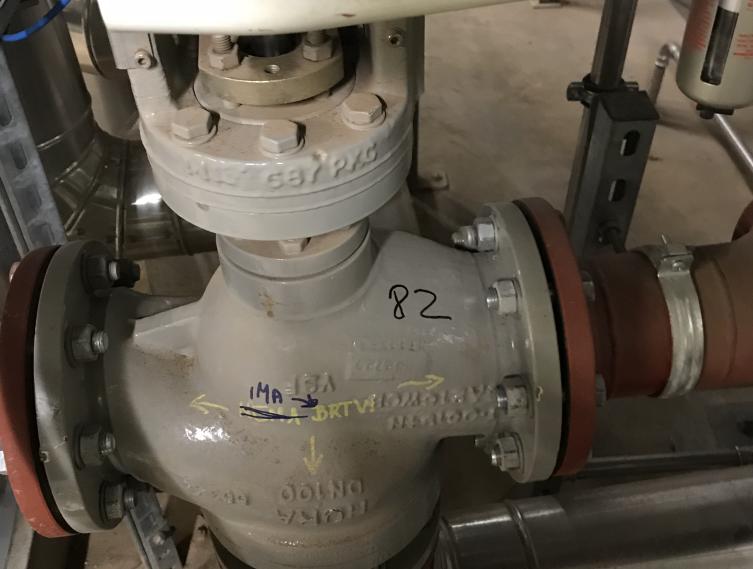
There are various types of valves, for example, ball valves, butterfly valves, gate valves or globe valves. To get the complete overview please have a look at the valve types from Hard Hat Engineer website. Each type has several manufacturers and plenty of sizes. That is why it’s extremely difficult to manufacture standard valve insulation jackets that would fit onto all these valve types. At the same time it is a great advantage of valve insulation jackets. If they are manufactured correctly these can fit tightly around the valve body and protect it against heat loss.
A lot of work is done during the design phase of industrial plant. Almost every single item is designed in 3D and can be measured in some sort of CAD or BIM software. Nevertheless, as built situation at construction site can differ greatly from the original design. Especially when it comes to insulation of mechanical equipment – pipe insulation, valve insulation, etc. Usually, insulation works are one of the last part of scope in construction sequence. Very often it is up to the insulation contractor to make changes in insulation design. These change needed to consider that insulation design works with already installed equipment.
From our experience it meant that pipes, valves or flanges are installed in close proximity to other equipment. Sometimes it was also building steel structure which was clashing with insulation. Such installation leaves less space for insulation of valves and other items. That is why site survey is a good solution in this case.
Site survey documentation for early design of valve insulation blankets
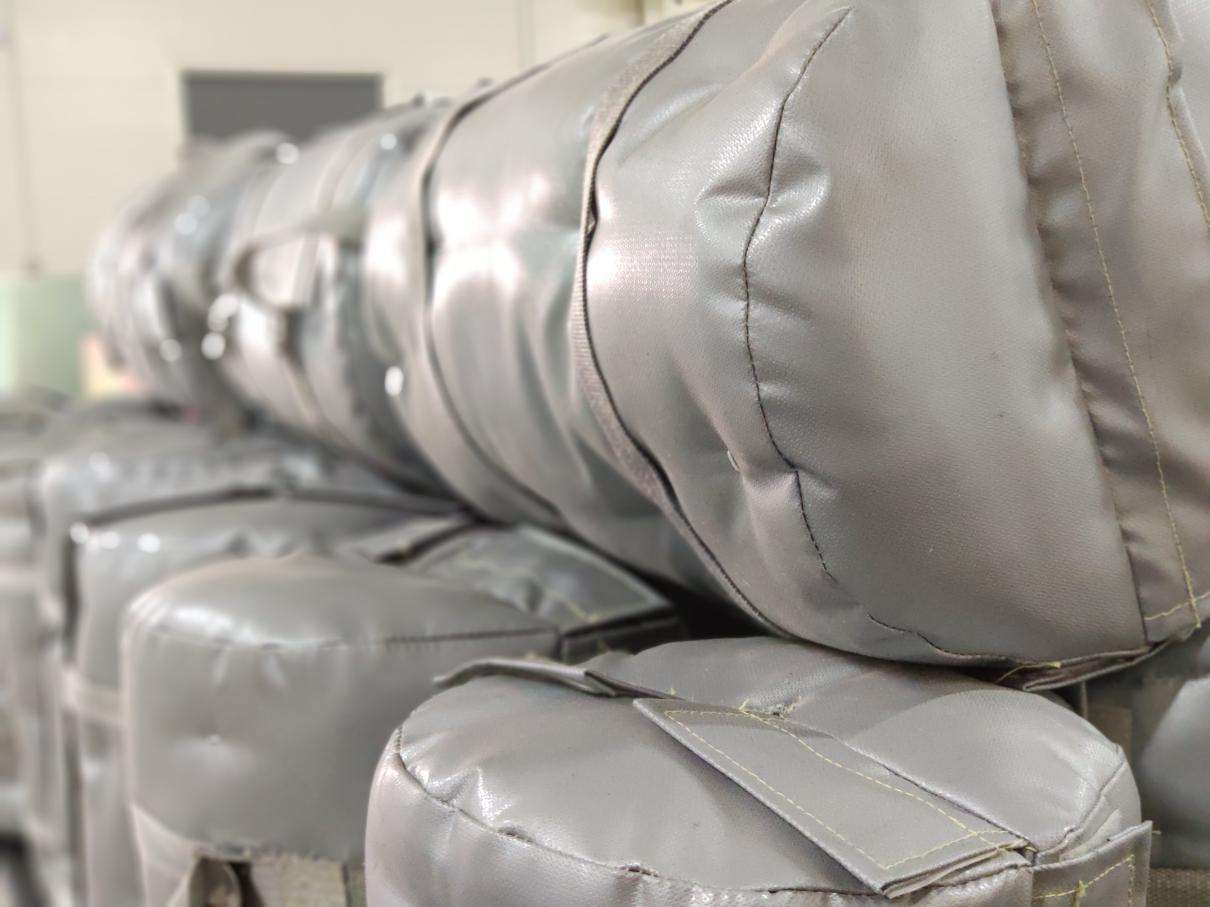
We visited the construction site several times to make sure we surveyed and took measurements for all valve insulation jackets. At the beginning it was like a jungle full of valves, pipes, ducts and other equipment. Thanks to good cooperation with the customer who helped us in navigating in that plant we managed to make sure each valve was checked. Also we knew specific situation for each removable insulation covers. During our inspections we made draft notes with sketches for valve insulation jackets and a list of all items.
The list included not only KKS numbers to identify specific removable valve insulation jacket. It also included insulation thickness, valve and pipe diameter, details about any cut-outs, location and additional id number. The same id number was marked on the valve itself. Later it was also engraved in metal tags fixed to the removable insulation covers. Thanks to this identification it was easier for the site installation team to locate and fix removable insulation mattresses in the right spot.
The site survey and the list not only consisted of valves. It also contained details about insulation for flanges, insulation for compensators and insulation for manholes.
After daily survey we sent the list to the design team. It allowed them to start early with proper drawings, estimation of surfaces and preparation of bill of quantities. With the combined details we were able to procure necessary insulation fabrics and insulation materials. Due to tight spaces between insulated valves and other items it was necessary to use insulation materials of low thickness and low thermal conductivity. Some of the materials we used were for example e-glass fibre mats or ceramic insulation mats.
Design of valve insulation jackets

Being thermal insulation blankets supplier with over 20 years of experience we knew that proper manufacture of pipe and valve insulation jackets starts with good design.
With all the information in hand like original design drawings, insulation specification, site survey and measurements, site photos valve jackets sketches, designers were able to start with drawings. Our team used CAD/CAM software to plan and space out numerous parts and to minimise the amount of waste and off-cuts. Designing of removable pads for small ball valves was quite challenging. It was necessary to provide insulation from high temperatures but at the same time large thickness made it difficult for the manufacturing. Some items required several layers of removable jackets. Designers introduced overlap and high temperature insulation fabric to minimise heat transfer.
Another matter which we considered during the design stage was the type of material in the outer and inner layer. These two sometimes differed due to specific requirements. For example internal fabric which was directly in contact had to be resistant to high temperatures. Whereas, external fabric did not need to comply with this, however, it had silicone or PTFE coating for abrasion or splash protection.
When designing removable insulation mattresses for access hatches or manholes we took into consideration the safety aspects as well. Larger and heavy items we divided into smaller parts. This way we ensured that site installation team and future maintenance team could lift and handle removable insulation pads manually.
Each valve insulation cover had its unique id number which matched the number the drawings. Designers delivered the drawings to the manufacturing hall on regular basis either after they drew certain type of valve jackets or when they completed specific area.
Valve jacket fabrication
Production of valve insulation covers took place at several workstations. It started with cutting the raw material from the roll. For this purpose ewe used our CNC insulation cutting machine. Factory supervisor ensured that the dimensions were correct and according to the drawings. After this check the insulation cover fabric went to sewing team. They used industrial grade sewing machines and specialist threads to join pieces of fabric together forming insulation blankets for valves.
Our factory personnel opened these parts and later filled them in with insulation material cut to size of the fabric elements. Once the production team stuffed removable valve jackets with an insulant, the insulation mattresses went back to the earlier work section. Sewing team closed the last seams of valve jackets.
Factory supervisor checked each completed removable jacket for damage and quality. After this inspection production team packed the insulation mattresses on pallets or into the boxes. Our supervisor compiled the packing list and labelled the pallets accordingly.
Logistics of 1500 valve insulation covers became a project on its own
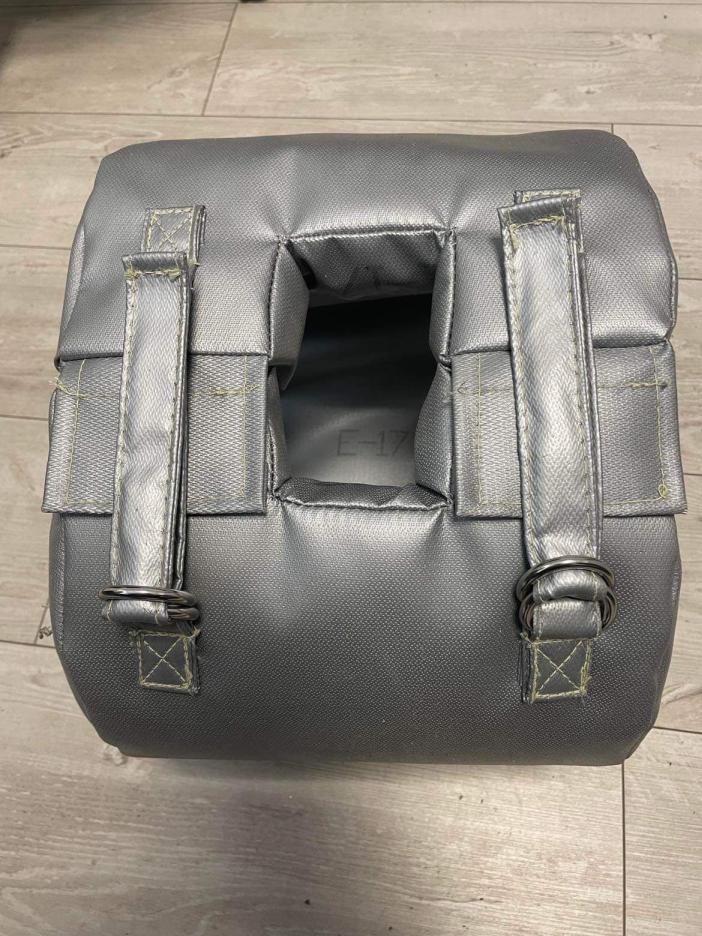
Our customer requested that we should split our deliveries of fabricated valve jackets into smaller transports. Transport charges created also additional logistic effort but the frequent delivery system had several benefits which were more valuable than the cost. Our customer was happy to employ this frequent delivery system because they minimised site storage requirements. And also to progress with site installation and to hand over selected areas to the plant owners.
Site team preferred smaller deliveries as it was easier for them to check deliveries and packing list and to install fabricated valve jackets. Regular transports were also beneficial to us as. We did not have to store the vast amount of valve insulation jackets in our factory. Good communication between the construction site and the factory resulted in smooth co-operation.
Did we learn anything from this valve insulation jackets project in the UK?
Every project is different and despite having over 20 years of experience in the valve jacket fabrication we learn continuously with each new job. This project was no different. We gained valuable knowledge and experience by working closely with the customers construction team on site. We made several mistakes during project duration, however, we were also able to quickly rectify them. These mistakes mostly included errors during writing and rewriting lists. Some id numbers got confused with drawings and some were mixed during packing. Nevertheless, we managed to identify these errors in time. We rectified them in such a way that the customer was able to install the removable insulation mattresses in correct locations.
There were also several insulation covers which did not fit properly on site. This issue resulted from the changes which happened on site between our site survey and delivery of finished product. Other contractors installed additional nozzles, instruments or pipes which others either closely to the valves or directly on the valves. During the site surveys we took hundreds of photos. However, after several weeks or months it’s difficult to remember all the details. Therefore, with the next project we will implement daily reporting app to track which works were done and to keep the records from the construction site.
In conclusion, managing such a large project was another challenge for us. However, it was also a valuable lesson of how we should work and communicate internally and with the customer. Valve insulation requires experienced removable insulation jackets supplier. And with our knowledge we were able to manufacture and to deliver insulation products of high quality.

Are you interested in valve removable insulation covers? Get in touch with us through the form below.
It’s a type of insulation cover that provides thermal insulation for a valve. Valve insulation covers can prevent heat loss, limit condensation on cold services, protect personnel from high heat and also protect the assets from freezing.
The choice of materials depends on several factors like operating temperature, ambient conditions and medium used in piping systems. Usually such an insulation jacket consists of external fabric, internal insulation material and fastening system.
There are several price influencers. Valve insulation jackets can cost from as low as £30 (approx. 35 EUR or 41 USD) up until £200-300 ( approx. 230 EUR – 250 EUR or 275 USD – 410 USD) per item. The main price driver is of course the size and surface. Other important aspects are service temperature and materials that can sustain such temperatures. Insulation jackets for valves can be single layer or multiple layers and consist of several parts.
We covered this topic in full here. However, in a few words, insulation jackets are easy to install, maintain, remove and replace. You don’t need specialist trades, nor special tools. You can install and remove valve insulation jackets manually. This lowers the maintenance costs. What is more, insulation jackets tend to sustain longer than metal cladding boxes around valves. The main reason is because jackets are flexible and don’t get damaged as much as metal boxes.
Except for standard heat protection insulation jackets we can support you also with a few specialised types.
These are:
– leak detection jackets – the jacket fabric can change colour if the valve leaks
– heating insulation jackets – these are insulation covers fitted with heating cables
– fire protection jackets – some plants require insulation jackets to be fire rated
Yes, our insulation jackets are fully customisable and fit all types of valves.
You don’t need any tools for installation or removal of valve jackets. Our fabricated valve jackets are easy for maintenance due to simple fixings like velcro straps or straps with buckles. It means that you can install them and remove manually, without tools.
Valve jackets are suitable for ball valves as well. These are simple to install and lightweight solution.
Yes, we do. We’ve had already several valve insulation covers projects in the UK. You can count on our experience with logistics and custom clearance.
Yes, our removable covers are suitable as steam valve insulation jackets.
There are several advantages of valve insulation jackets over the valve boxes from metal sheet. Firstly, removable valve jackets are lighter due to the use of textile fabrics instead of metal sheet. Secondly, flexible jackets are less prone to damage. Thirdly, contractors tend to remove insulation boxes and leave them on the floor as they don’t know how to put them back on. With flexible valve jackets, the process is easy and doesn’t require any tools.
Such a limit depends on the materials used in the valve blankets. Standard fabricated valve jackets can be used up to 250°C, we can also implement fabrics for higher temperatures like 500°C or 600°C.
Do we supply valve insulation jackets to London?
Yes, we’ve had already several valve insulation covers projects in the UK.
16 responses